John Ruskin an Art Critic From the 1800s Said That He Believed the Test of a Truly Great Man Was
1. Ruskin
John Ruskin was one of the most influential English writers of the nineteenth century. In the 1840's, while still in his early on twenties, Ruskin began his start volume, Modernistic Painters. This volume was designed as a defence of the English painter Turner, only it gradually grew into a v-volume work on painting in general. Ruskin followed Modernistic Painters with The Vii Lamps of Compages and The Stones of Venice. These two works praised Gothic architecture, and contributed to the architectural motion known as the Gothic Revival. Ruskin was the first major writer to devote himself to visual art. The popularity of Ruskin'southward works on painting and architecture was a factor in the establishment of art history as a branch of study at major universities. The public was ravished by Ruskin'south eloquent descriptions of nature and art.
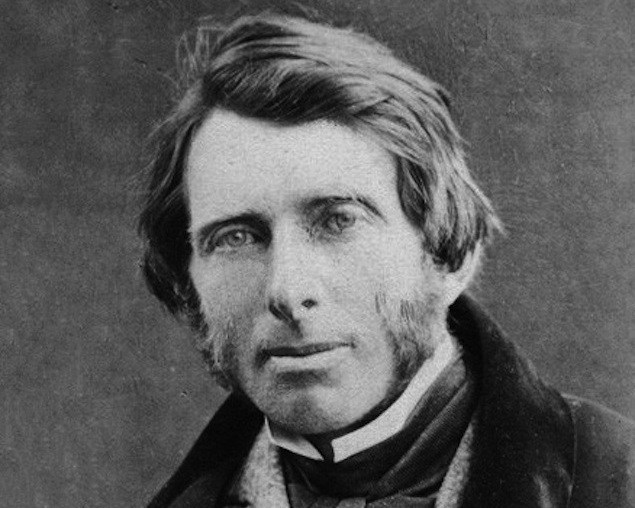
John Ruskin
Ruskin teaches his readers to see; after reading Modern Painters, Charlotte Bront� said that she felt she had been given a new sense — sight. Ruskin teaches his readers to capeesh nature — to observe clouds, shadows, trees that they hadn't noticed before. Ruskin besides teaches his readers to appreciate architecture — to notice cornices, moldings, pediments that they hadn't noticed earlier. Ruskin educates his readers by giving them a greater appreciation of the globe around them — both natural and man-made.
During the nineteenth century, European intellectuals seemed to become more fervent most fine art as they became less fervent most religion; fine art was becoming a new faith. Ruskin, the leading art critic of the nineteenth century, was more than a critic, he was a prophet, he stirred people'southward deepest feelings. Proust had so much admiration for Ruskin that he stumbled through everything Ruskin wrote, despite his scanty cognition of English. Proust even translated two of Ruskin's books into French. Proust said of Ruskin, "When I come across how mightily this dead man lives, I know how slight a thing death is." Tolstoy said, "Ruskin was one of the most remarkable men, not only of England and our fourth dimension, but all countries and all times. He was one of those rare men who call back with their hearts."
Just as Mencius thought that just a good man could write skillful prose, so Ruskin thought that only a good man could create good fine art. And if an creative person didn't enjoy his work, if his heart wasn't in it, it wouldn't exist good art; according to Ruskin, only the happy artist could create good art. Ruskin didn't hash out art by itself, he discussed art in the context of morality, religion, politics, etc. Ruskin continued art to life in general, and thus his art criticism often reaches the level of philosophy. Ruskin believed that modern homo couldn't create good art because he didn't pb a good life, considering he had no religion except the worship of wealth. "A nation cannot last," said Ruskin, "equally a money-making mob: it cannot with impunity... proceed despising literature, despising science, despising fine art, despising nature, despising pity, and concentrating its soul on Pence."1
Ruskin gradually evolved from an art critic into an economist. Just as he had connected fine art to life, so too he connected economics to life. He insisted that wealth and applied science were worthless if they didn't aid people to live meliorate. He insisted that, "there is no wealth but life."2 His best-known piece of work on economics is Unto This Last, a curt, powerful book that criticized capitalism. Unto This Last inspired the founders of the British Labor Party, and also inspired Gandhi, who translated it into one of Bharat'south dialects. Many of the ideas expressed in Unto This Terminal accept become widely accustomed in our time, such as the idea that there should be an esprit de corps betwixt labor and management.
Ruskin's complete works fill many volumes because near of his books are lengthy, and many of his lectures have been published. His best short works are the essay "Traffic," The Seven Lamps of Architecture and Sesame and Lilies.3 The Darkening Glass: A Portrait of Ruskin'southward Genius is an excellent commentary on Ruskin's works. The Genius of John Ruskin is the best album of his writings.
2. Berenson
Bernard Berenson was born into a Jewish family in Lithuania in 1865, but grew up in Boston. Like many intellectuals, Berenson read voraciously during his teenage years. Later studying ancient languages at Harvard, Berenson received a scholarship to go on his language studies in Europe. While he was in Europe, he became interested in visual fine art, and he discovered that there was much doubt about who had painted what. While having breakfast with a friend at an Italian caf�, he decided to make a thorough written report of Italian painting, using the scholarly methods he had learned every bit a language student. "Here at Bergamo," he said to his friend, "and in all the fragrant and romantic valleys that branch out north, we must non stop till we are sure that every Lotto is a Lotto, every Cariani a Cariani, every Previtali a Previtali."4
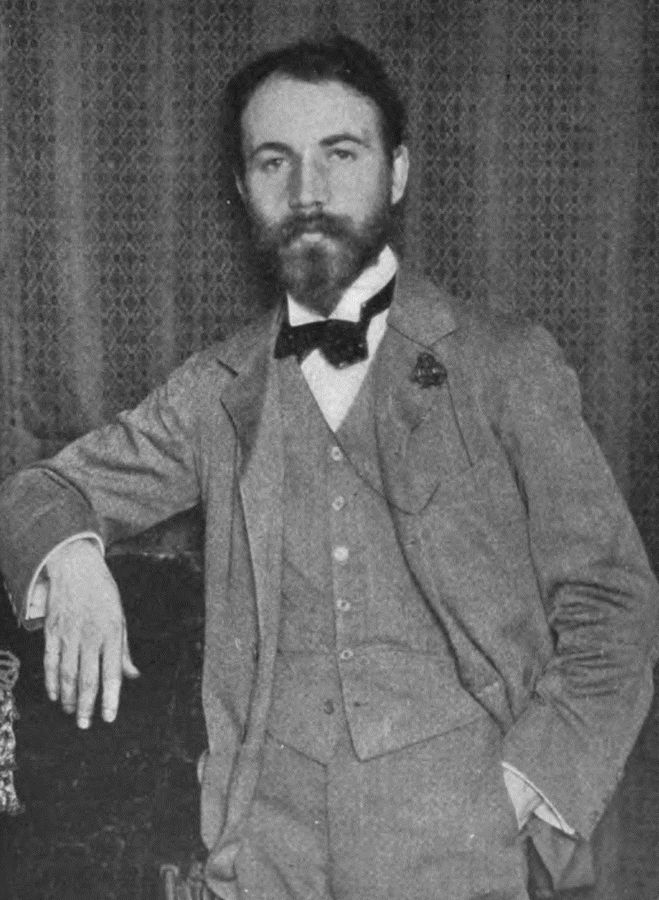
Bernard Berenson
Berenson'south offset books were on Italian painting. The Harvard professor William James, who had taught psychology to Berenson, praised Berenson's early work for its application of psychology to art criticism. One of Berenson's early on works, Italian Painters of the Renaissance, is a favorite of mine — highly readable and interesting. Like Freud, Berenson turned to more than general, philosophical works in his after years. These tardily works — such every bit Sketch for a Self-Portrait and Aesthetics and History in the Visual Arts — might be the best "forgotten books" of the 20th century. Art specialists accept little employ for these late works, which were written for educated laymen, for generalists. These belatedly works have no audition today because, in our specialized historic period, generalists are an endangered species.
Though he was a U.S. citizen, Berenson spent most of his life in Italy. He was oft consulted by people who wanted to cosign paintings, and his consulting piece of work made him rich. He bought a spacious abode near Florence, I Tatti. When Earth War Two broke out, he couldn't bear to go out his beloved home, and then he lingered in Italy until it became impossible to leave; somewhen the Germans took over his house, and he barely avoided arrest.
Similar Hemingway, Berenson was known for his practiced looks and his numerous affairs. Like Hemingway, Berenson had female descendants who were famous actresses/models. Berenson had the complicated, multi-faceted personality that Hemingway had. Hemingway'southward first wife, Hadley, said that Hemingway had as many different facets as the sketches in a geometry text. Likewise, Kenneth Clark said, "The personality of Mr. Berenson was so strange and circuitous."5
While Ruskin exemplifies the Victorian historic period, Berenson represents the intersection of the nineteenth century and the twentieth century. Berenson lived through both world wars, and finally died in 1959 at the age of ninety-four. Berenson tried to carry classical Western culture into the twentieth century. Berenson defended the old values of Western civilization when they were threatened by totalitarian politics and by "modern fine art." Berenson lacks Ruskin's moral fervor. But Berenson didn't bury himself in the fine points of painting; he believed that visual art should be part of culture in general, and civilisation should be office of life. Berenson published several volumes of journals, journals that integrate civilization and life. His passion for culture didn't flag in his old historic period; when he was fourscore, he wrote a book called Ane Year's Reading for Fun.
Similar many people before him, Berenson enjoyed life more when he felt it drawing to a close; when he was approaching 90, he said, "I would willingly stand at street corners, hat in hand, asking passers-by to drib their unused minutes into it."half dozen He was unwilling to die, and leave his house and library; he wanted to stay around after death, and haunt it. Surrounded past his books, his paintings, his gardens, and his friends, Berenson said, "I have attained Goethe'southward promise that what one ardently desires when young one will realize in old age.... It is easy now to live in ecstasy."7
3. Other Art Historians
It's symptomatic of the decline of modern culture that Berenson'south proper name isn't widely known, and his works aren't readily available. Some other modern writer on fine art, Kenneth Clark, is more than widely known than Berenson, partly because he made a television set documentary, "Civilisation." Clark wrote excellent prose. I recommend all of Clark's books: Rembrandt and the Italian Renaissance, Leonardo, etc. One might describe Clark as a member of the English school of art history, a school that began with Ruskin; Clark was fascinated by Ruskin, and edited some of his books.
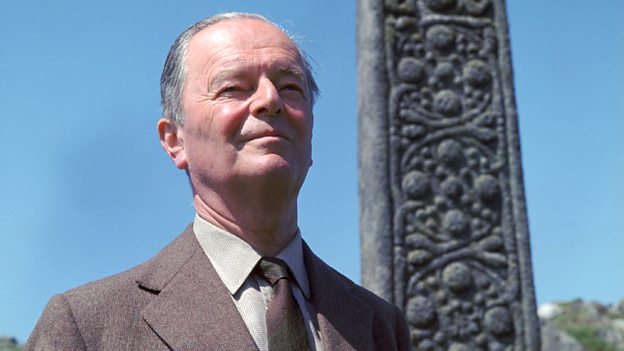
Kenneth Clark
The German language school of art history began with Jacob Burckhardt (whom we discussed earlier), and continued with W�lfflin and Panofsky. Burckhardt lived in Switzerland, and during the summer he would walk to Italy to written report painting and architecture, then render to Switzerland in the fall, and lecture at the Academy of Basel about the art works he had seen. Burckhardt wrote Cicerone, which attempts to describe all of Italy'south major art works. Burckhardt's disciple, Heinrich West�lfflin, was more than precise and scientific than Burckhardt, and Panofsky is even more than scholarly than W�lfflin. Ane might compare Burckhardt to a traveler who spends one night in each city, W�lfflin to thetaveler who spends the whole summer studying the fine art works of i city, and Panofsky to a traveler who spends the whole summer studying the works of i creative person in one city. Maybe every branch of knowledge goes through a similar evolution, from broad survey to narrow specialty.
W�lfflin focused on Renaissance and Baroque art, analyzing the differences between these ii periods, and attempting to develop a thousand theory of artistic forms. Though his piece of work is occasionally dry and dull, it contains a deep noesis of art, and a patient reader will find information technology rewarding. West�lfflin writes thus of Michelangelo:
His interest was in the definition of form, and merely the human body seemed worthy of representation to him, for whom the infinite variety of created things just did not exist. For him, the human being race was non the humanity of this world, with its thousands of different individuals, just a race autonomously, transposed into the colossal.8
Erwin Panofsky was built-in in Germany; only Germany could have produced such an brainy, scholarly author. Because he was Jewish, Panofsky left Germany in 1933, and came to the U.S.; he ceased writing in German, and began writing in English. He was most as prolific as Kenneth Clark, treating a wide variety of subjects, including Albrecht Durer, the Renaissance, and Gothic architecture. His specialty was iconology — that is, the meaning of artistic symbols. For example, Durer's Fall of Man contains, in addition to Adam and Eve, a variety of animals — a mouse, a rabbit, etc.; Panofsky tries to explain what these animals signify. Panofsky's work is dry out and difficult to read; he puts two or three footnotes on each page, every bit if to test the reader's patience. If the reader has sufficient patience to keep going, he'll find that Panofsky's work is full of profound thoughts and valuable insights.
Rudolf Wittkower was likewise born in Germany, and also spent much of his career in the U.Due south. Though not as well-known every bit Panofsky, Wittkower acquired a high reputation among fine art historians, chiefly for his works on the Italian Baroque. He also wrote a book of short biographies with his wife, Margot; it's called Born under Saturn: The graphic symbol and conduct of artists (it was believed, during the Renaissance, that Saturn's influence caused genius and melancholy).
I tin can't exit the subject of art without mentioning James Cahill'south masterpiece, Chinese Painting. Cahill's volume is articulate, curtailed, profound, and well suited to both the specialist and the general reader. The evolution of Chinese painting styles and aesthetic theories is a remarkable story, a story that will fascinate anyone interested in culture.
four. Tocqueville
Tocqueville'south Commonwealth in America is more than than a study of American society, it's a written report of democracy in general, and of modern society in full general. Democracy in America is 1 of the outstanding works of mod times — profound, philosophical, readable. It's on a par with Ortega's Revolt of the Masses, a book which it resembles in many ways. Though Tocqueville, similar Ortega, is generally critical of modern society, his goal is to understand, not to criticize, hence he mixes praise with blame. Democracy in America would be improve if it were written in aphoristic course, or if it were skillfully abridged; some of its chapters are dry, and others are repetitious.
Tocqueville matured rapidly and died young. He wrote Democracy in America when he was in his belatedly twenties, and he died earlier completing the multi-volume work on the French Revolution that he had planned to write. He did, however, consummate The Old Government and the French Revolution, which is an first-class book. Many of the features that Tocqueville institute in America, such as political and social equality, he likewise constitute in France.
Equality, according to Tocqueville, is the central fact of modern times. Formerly, says Tocqueville, people felt themselves to be part of a class, a group, or a guild, they didn't experience themselves to be individuals, and even the word "individuality" was unknown. Modern society, however, is virtually classless, and people don't feel themselves to be part of anything greater than themselves. Even the family has lost its importance, and only the individual remains.
The modern individual, says Tocqueville, cares little about the by or the time to come, little about religion or culture. The modern individual's master concern is money. Though his life is filled with activity, he has no high goals, no vast ambitions, no deep thoughts. Tocqueville is pessimistic about the future of Western civilization:
I fearfulness that the heed may continue folding itself up in a narrower compass forever without producing new ideas, that men will wear themselves out in trivial, lone, futile activeness, and that for all its constant agitation humanity will brand no accelerate.9
Tocqueville has been translated into English language numerous times; perhaps the best translation is Arthur Goldhammer�south.
5. Solzhenitsyn
Solzhenitsyn, in his speech at Harvard in 1978, remarked on several of the aforementioned traits in Western social club that Tocqueville observed. Like Tocqueville, Solzhenitsyn observed that Western man is obsessed with material things:
The abiding desire to accept nonetheless more than things and a still better life and the struggle to this end imprint many Western faces with worry and even low.... This active and tense competition comes to dominate all human thought.
Like Tocqueville, Solzhenitsyn observed that there is niggling intellectual liberty in the West, since the media, academia and public opinion reject and persecute views that are outside the mainstream.
Solzhenitsyn notices several traits in Western society that hadn't all the same appeared in Tocqueville's fourth dimension. For example, Solzhenitsyn notices a pass up in the arts, a turn down of courage, an invasion of advertising, and an emphasis on individual rights that leaves society at the mercy of criminals. In brusk, if Tocqueville's picture of Western society is dour, Solzhenitsyn's is bleaker even so.
Destructive and irresponsible liberty [says Solzhenitsyn] has been granted dizzying space. Society has turned out to have scarce defense confronting the abyss of human decadence, for example against the misuse of liberty for moral violence against immature people, such equally motion pictures full of pornography, offense, and horror.
If one considers Solzhenitsyn's Harvard speech to exist an essay, information technology'southward 1 of the most powerful essays ever written; one can't praise information technology also highly. It has brevity, the rarest of literary virtues. I besides recommend a speech by Solzhenitsyn called "The Relentless Cult of Novelty," in which he criticizes advanced art.10 Solzhenitsyn's all-time books are his non-fiction works, The Gulag Archipelago and The Oak and the Dogie; I don't recommend his fiction, which is as harsh and unpleasing as lemon juice.
The purpose of The Gulag Archipelago is to tell the story of the prison camps run by the Russian Communists, and to make certain that the sufferings of the prisoners are remembered. The Gulag is full of vivid stories and interesting anecdotes. Just Solzhenitsyn is so appalled by the crimes of the Communists, and and so intent on describing them to the globe, that he gives the reader too much item, and the upshot is a book about 2,000 pages long. This raises questions: is the Gulag a great literary piece of work? Is information technology a literary work at all? Fortunately, a good abridged version has been made by Edward Ericson. I suggest that the reader get-go with this abridged version, and so go on with The Oak and the Calf, which describes how Solzhenitsyn wrote the Gulag, how he published it in the face of government opposition, etc. I as well recommend Michael Scammell'south long biography of Solzhenitsyn.
Solzhenitsyn is a man on a mission; his mission is to tell the world nigh one of the greatest crimes in the history of mankind, the murder of around 20-25 million Soviets, who were tortured to death, worked to expiry, frozen to expiry, and starved to death by the Soviet regime.
Another eyewitness account of Stalin's camps is Journey Into the Whirlwind, by Eugenia Ginzburg (the sequel is called Within the Cyclone). Robert Conquest wrote various books about Stalin�s regime, including The Corking Terror: Stalin�due south Purge of the Thirties. Conquest was a poet equally well as historian.
6. Flower and Edmundson
Bloom'due south Closing of the American Mind, published in 1987, discusses some of the aforementioned subjects that Solzhenitsyn discussed. Merely Bloom, being an American, has a more intimate cognition of Western society than Solzhenitsyn. For example, Bloom understands the importance of rock music in Western society:
Goose egg is more singular about this generation [writes Bloom] than its addiction to music.... Today, a very big proportion of young people between the ages of 10 and xx alive for music.... Stone music has 1 appeal only, a barbarian entreatment, to sexual desire — not love, not eros, merely sexual desire undeveloped and untutored.xi
Flower's primary interest is higher education, hence the subtitle of his book is, How Higher Teaching Has Failed Democracy and Impoverished the Souls of Today's Students. Bloom points out that today'southward students take little interest in reading serious literature; today'south students can see that a knowledge of the humanities won't help them in any career. Today's professors are specialists who have no involvement in civilisation every bit a whole. Today's colleges divide culture into departments, and neglect to provide a general didactics.
Though Bloom's book is occasionally interesting, it isn't every bit profound or every bit concise as Solzhenitsyn's speech. While Flower has talent, Solzhenitsyn has genius. Though Blossom'due south book is one of the classics of our time, it isn't one of the classics of all time.
Near x years later on Blossom'due south book appeared, Mark Edmundson wrote an essay that was widely read and widely discussed, an essay that resembles Flower's book. Like Flower, Edmundson criticized American higher education, and championed the classics. But while Bloom was fond of Plato and Leo Strauss, Edmundson was fond of Emerson and Whitman. Edmundson's essay ("On the Uses of the Liberal Arts") is a superb literary work, too as a penetrating critique of the modern soul. Both Bloom and Edmundson argue that modern human being doesn't worship heroes, doesn't adore geniuses, because he wants to feel "comfortable in his skin without having to suffer unpleasant comparisons."12
7. Matthew Arnold
While Tocqueville, Solzhenitsyn and Bloom have a special interest in American order, Matthew Arnold has a special interest in English lodge. Arnold was a leading Victorian poet, as well as a literary critic and social critic. Arnold's essays — "Culture and Anarchy," "Republic," and "Equality" — hash out English society in the tardily 1800's, just as Blossom discusses American lodge in the tardily 1900's. Arnold reminds his contemporaries of the importance of civilization; he argues that freedom, the correct to speak one'due south mind, and the right to vote, are of little value if the people lack civilization, lack loftier ideals, and lack slap-up thoughts. Freedom, according to Arnold, is "one of those things... worshipped in itself, without plenty regarding the ends for which liberty is to be desired."13 Freedom in modern order, says Arnold, isn't leading to any loftier goal, it's leading only to anarchy. Likewise, Arnold says that physical wellness is now being worshipped for its own sake, not every bit part of a higher ideal. Arnold argues that health and fettle shouldn't exist ends in themselves, merely every bit wealth shouldn't exist an end in itself.
Arnold'south essays are more elegant and cultured than Bloom's Closing of the American Mind, simply they aren't as profound every bit Tocqueville'due south Democracy in America, or Solzhenitsyn'due south Harvard speech. Arnold'southward essays are written for his time, not for all fourth dimension, hence they're a kind of journalism, not existent literature. If you want to read a book about Arnold, consider Lionel Trilling's Matthew Arnold.
8. Max Weber
Weber's proper noun has become synonymous with sociology. Weber's most famous book is The Protestant Ethic and the Spirit of Commercialism. This volume, similar many of Weber's writings, opposes the Marxist view that a nation'due south economic system shapes its worldview; Weber argues that, on the contrary, a nation'southward worldview shapes its economy. In The Protestant Ethic, Weber argues that Protestant behavior shaped capitalism.
Weber discusses the profound impact that ascetic Protestantism had on the Anglo-American peoples. He says that it destroyed their spontaneity, and even affected their facial expression. (Frenchmen have oftentimes described Englishmen as gloomy.) Weber blames ascetic Protestantism for creating the near materialistic civilisation in history. The Heart Ages had glorified poverty and begging; some monastic orders relied on begging to support themselves. Ascetic Protestantism, on the other hand, glorified work and material wealth.
While The Protestant Ethic is an interesting and readable book, most of Weber'due south other books are dry. One of his books, all the same, is even more interesting than The Protestant Ethic: his book on Confucianism and Taoism. This book not only explores Confucianism and Taoism, it explores Chinese civilization and the Chinese soul. It sheds light on Western civilization past contrasting it with Chinese civilization. And finally, it discusses Weber'southward central thought, namely, the thought that religion and ideals shape economic life.
Weber observes that the Chinese have a certain calmness, a tranquility, a "hitting lack of 'nerves'," an "unlimited patience."14 Weber ascribes these traits to organized religion, to the absence of the ascetic religious practices plant in the Due west; he also ascribes these traits to a relatively depression usage of alcohol. Weber says that in that location was no tension in Prc between "nature and deity," betwixt "consciousness of sin and need for salvation"; such tension was at the eye of Western civilization. While the Chinese quietly adapted himself to the world, the Westerner rejected the earth, aspired toward the perfection of God, and tried to transform his ain nature.
An interesting sketch of Weber himself can be found in the introduction to a book called From Max Weber: Essays in Sociology, edited by Gerth and Mills.
9. Thorstein Veblen
Veblen was an American professor of economics who did most of his writing in the early 1900's. Veblen doesn't deal with economics in the narrow sense, merely rather with sociology and cultural anthropology. Veblen is all-time known as the author of The Theory of the Leisure Class, a book which sets forth Veblen'southward famous theory of "conspicuous consumption." Veblen is 1 of the three or four most profound thinkers that America has produced. He has a fresh perspective on human affairs, and he sheds light on many aspects of lodge.
Just as Huizinga interpreted homo diplomacy in terms of play, and so Veblen interprets man affairs in terms of status. The Theory of the Leisure Form begins by arguing that people desire status, they want the esteem of other people; simply exceptional individuals are satisfied with the contempt of other people. How is status obtained? At an early period of history, says Veblen, condition was obtained by trophies, by symbols of success in war or hunting. Status could be lost by manual labor, so some hunters had their wives carry the game they had killed back to their habitation, lest they lose past working the condition that they had won past killing. At a afterwards bespeak in history, status was obtained by titles of nobility, coats of arms, etc. Status was too obtained by the possession of numerous women, and numerous slaves or servants.
When Veblen looks at gimmicky society, he finds that men who can't afford servants must rely on their wife to symbolize wealth and obtain condition. Wives can symbolize wealth by leisure, by not working. If leisure were hidden and inconspicuous, it wouldn't confer condition, hence leisure must exist flaunted, it must be conspicuous. A woman'south leisure tin be displayed past having long fingernails, high-heeled shoes, clean clothes, and annihilation else that's incompatible with manual labor. Men tin prove they aren't laborers, and acquire status, by wearing clean white shirts, shiny shoes, etc. Veblen says that the Chinese custom of pes-binding was a means of displaying a adult female's leisure and obtaining condition.
But leisure isn't the simply way to obtain status; consumption can also obtain status. But consumption, similar leisure, must be flaunted, information technology must be conspicuous. An expensive car, for example, is a conspicuous form of consumption considering it's visible even to people who never see your habitation or your wife's diamond ring. People strive for wealth, says Veblen, not merely to live, but to obtain condition through conspicuous consumption.
Veblen applies his theory of condition to faith, and argues that God is the prototype of status. He compares priests to footmen who confer status on their main, and he compares churches to huge palaces that confer status on their owner. He notes that people come to church in their cleanest, most expensive clothes, and they abstain from work on holy days.
The theory of condition is Veblen's fundamental theory, but information technology isn't his only theory. Veblen's writings are full of interesting ideas. I recommend Imperial Germany and the Industrial Revolution, "Christian Morals and the Competitive System," "Salesmanship and the Churches," "The Higher Learning," and "Patriotism and the Cost System."
10. Morris and Lorenz
Desmond Morris is an Englishman who specializes in the report of animals. During the final few decades, Morris has written many books, some about animal behavior, others about human being behavior. Like Veblen, Morris has a fresh and interesting perspective on human diplomacy. While Veblen viewed human being affairs in terms of status, Morris views human diplomacy from the standpoint of beast beliefs. Like Veblen, Morris tin deepen one's understanding of man, and of everyday life.
Morris is a student not of homo thought, man history, or human nature, but rather of human behavior. He observes how people act — how they walk, how they hold themselves, how they greet each other, etc. He notes that in some primitive societies, people prostrated themselves before their male monarch or their master. Later, kneeling replaced prostration. Later yet, curtsying and bowing replaced kneeling. Curtsying is a sort of bootless kneeling, it shows an intention to kneel. Bowing is a way of lowering oneself, and thus showing respect for another. Removing i's hat is also a style of lowering oneself. Saluting is "a stylized modification of the act of removing the chapeau," but equally curtsying is a stylized modification of kneeling. Embracing was one time a common form of greeting, and is notwithstanding institute in the Latin countries. Russians, like the ancient Greeks and Romans, greet each other past kissing. Morris says that the British restrict body contacts, and prefer the handshake to the embrace. (As Weber said, ascetic Protestantism had a profound affect on the Anglo-American peoples.) When people stand up erect and shake easily, information technology's a sign of equality, it's the opposite of prostration, which is a sign of inequality. (As Tocqueville said, equality is the distinguishing feature of modern society.)
When we feel uneasy, says Morris, nosotros oft "rearrange ornaments, light a cigarette, clean our spectacles, glance at a wrist-watch, pour a drink, or crumb a piece of food."xv Morris calls these "displacement activities," and he observes something similar in the brute world. Observing a grouping of chimpanzees, Morris notices that subordinate individuals "tin hands be identified by the higher frequency of their displacement cocky-training activities. The truly dominant individual tin can be recognized past the almost consummate absence of such actions."16
Morris isn't a literary human, and he has little interest in prose style. Morris won't be as interesting to posterity equally he is to us, because human being behavior won't be a new and unexplored field to posterity. If Morris' works are classics, they're mortal classics, non immortal classics. The Naked Ape, Morris' all-time-known book, is a skillful introduction to human behavior. I besides recommend The Man Zoo, Intimate Behaviour, and Fauna Days.
While Morris writes for laymen, Konrad Lorenz, another pupil of beast behavior, writes mainly for specialists and scholars. While Morris applies his knowledge of animals to the study of humans, Lorenz by and large stays inside the field of animal behavior. But some of Lorenz's remarks on animals have obvious analogies in the sphere of human behavior. Lorenz says, for instance, that
a young female [goose] that has fallen in love never tries to force her company on the object of her passion. She never follows him directly when he walks away; she simply turns upwardly, as if by hazard, in places where she knows he can often be found.17
Lorenz notes that animals can communicate through not-verbal means: "It is incredible, what minimal signs, completely imperceptible to human being, animals will receive and interpret rightly."18
Lorenz'south best volume is King Solomon's Ring. I recommend information technology highly; information technology's a fascinating, concise and readable piece of work on animal beliefs. I also recommend On Assailment, which argues that aggression often plays a constructive role among animals; co-ordinate to Lorenz, aggression isn't simply the production of the death-instinct, as Freud had argued.
eleven. Richard Feynman
"Surely You're Joking, Mr. Feynman!" is a book almost the life of the American physicist, Richard Feynman. It'southward an interesting and amusing book that achieved broad popularity. Feynman had an inquiring listen and an abundance of vital free energy, and he had many wild adventures during his life. Feynman was more than than a Nobel-Prize-winning scientist; he was also a talented creative person and musician. One of the people whom he played drums with, Ralph Leighton, was fascinated by his stories, and idea they should exist collected in a book; "Surely You're Joking" is Leighton's drove of Feynman's stories.
This is a case of a proficient book existence created simply and naturally; this is the oldest form of literature — oral literature, storytelling. Feynman told stories because he loved them; Leighton listened to the stories, and later collected them, because he loved them. Feynman didn't sit down down at a desk and say, "I'chiliad going to write a book because I'm a author," or "I'1000 going to write a book considering I need to make money," or "I'1000 going to write a book because I tin can't get a professor if I don't." Some of Feynman's stories are funny, some are thought-provoking, some requite the reader an insight into the world of modern science.
Unfortunately, this volume has vices also equally virtues. Similar nearly mod books, it's an united nations-cultured, un-literary book, and it lacks that rarest of literary virtues, brevity. One suspects that the publisher said, "let's make this a long book, a 350-folio book, so that people will be more apt to buy information technology, and will be willing to pay more for it. Thus, nosotros'll maximize our profits." "Surely Yous're Joking" was written to succeed in the modern marketplace, and to satisfy the casual, modern reader. It'southward a good modern book, only it falls short of being a classic.
Feynman often wrote for a general audition. If you want to learn nigh physics, try Feynman'due south Six Like shooting fish in a barrel Pieces: Essentials of Physics Explained by Its Nearly Vivid Instructor.
12. Toffler
Alvin Toffler is a contemporary American writer who deals with sociology, economics and "futurology" (that is, forecasting hereafter developments). I recommend Toffler'south volume, The Third Wave, which paints a comprehensive picture of contemporary club. Toffler distinguishes Third Wave civilization from industrial-historic period civilization, which he calls 2nd Wave. In Toffler's view, the French Revolution and the Russian Revolution represented the triumph of Second Wave, industrial civilization over Commencement Wave, agronomical civilization. Toffler's book offers the reader a view of modern history through the lens of economic science, and it offers the reader a highly readable sketch of the industrial revolution.
Our age is frequently called the Postal service-Industrial Age, or the Consumer Historic period, or the Information Age. According to Toffler, "For Third Wave civilization, the virtually basic raw textile of all — and i that can never be exhausted — is information, including imagination."19 At the center of the Information Age is the computer; Toffler accurately predicted the personal computer nail. The computer leads to more than people working at dwelling; Toffler predicts that, "the home will presume a startling new importance in 3rd Wave culture."twenty
While Second Wave civilisation was mass-oriented — mass product, mass media, etc. — Third Wave civilization is individualized. Toffler notes that George Orwell predicted a future that was increasingly mass-oriented. Speaking of Orwell's 1984 and Huxley's Brave New Globe, Toffler says,
Both these brilliant books... paint a future based on highly centralized, bureaucratized, and standardized societies, in which individual differences are eradicated. Nosotros are now heading in exactly the opposite direction.... People today — more than affluent and educated than their parents and faced with more life choices — simply reject to be massified.21
13. Riesman
David Riesman was an American sociologist. Riesman's fame rests on a book called The Lonely Oversupply: A Study of the Irresolute American Grapheme, which was published in 1950.22 Riesman's work is more timely than Veblen'southward and more profound than Toffler'due south.
While Toffler sees history in terms of 3 types of economic system, Riesman sees history in terms of three types of character: tradition-directed, inner-directed and other-directed. The tradition-directed person follows the traditions of his family and his village. "The tradition-directed person... hardly thinks of himself every bit an individual. Yet less does it occur to him that he might shape his own destiny in terms of personal, lifelong goals."23 The inner-directed grapheme, which arose around the time of the Renaissance, feels himself to be an individual, with his own goals. The other-directed character, which arose in the 20th century, tries to heed social cues, and get along with his peers. The famous names from history don't move him to envy and emulation.
The Lonely Crowd helps one to empathize the modernistic character, simply as The Third Wave helps one to understand the modern economic system.
14. Philip Howard
The Decease of Common Sense: How Law is Suffocating America is a brief, readable assay of the American legal system. The author, Philip Howard, is a New York lawyer who is active in borough affairs; Howard deserves credit for his effort to improve New York. The Expiry of Common Sense emerged from Howard'southward many years of political experience, and information technology includes numerous anecdotes culled from the contemporary scene. Many people felt that the American legal system had gone awry, and when Howard'south book was published, it jumped to the elevation of the bestseller list because it described the problem, and explained its causes.
Howard describes how individual rights have multiplied, and how government regulations take multiplied. Government power is reduced by the profusion of individual rights, and authorities officials are shackled by detailed regulations. Though Howard's way isn't elegant, and his ideas aren't profound, his volume is a valuable assist to understanding contemporary gild.
In addition to The Death of Mutual Sense, Howard has written iii other well-regarded books, The Collapse of the Common Proficient, Life Without Lawyers, and The Rule of Nobody.
15. Laurens van der Post
Laurens van der Mail service was born in South Africa in 1906, the thirteenth of fifteen children. When he was 20, he co-edited a educatee magazine that advocated greater racial integration in South Africa; the magazine was before long shut down past the government. And then van der Post and 1 of his literary friends hitched a ride to Tokyo on a Japanese freighter — an adventure that van der Mail service discussed many years later in his autobiographical work, However Beingness Someone Other.
Returning to South Africa, van der Mail service began working as a journalist in Greatcoat Boondocks. He was critical of racial separation. Just as Lincoln predicted that, in the U.South., blacks and whites would eventually be amalgamated into ane race, then van der Mail predicted, "the process of leveling upwards and inter-mixture must advance continually... the time to come civilization of South Africa is, I believe, neither black or white just brown."
In the early on 1930s, van der Post lived in England, and became acquainted with The Bloomsbury Grouping — John Maynard Keynes, East. M. Forster, Virginia Woolf, etc. Woolf and her husband, Leonard Woolf, published van der Post's first novel, In a Province, through their publishing company, Hogarth Press; this novel dealt with race relations in Due south Africa.
When Earth War Two bankrupt out, van der Post volunteered for the British army (ironically, his begetter had fought against the British in the Boer State of war). He served first in East Africa, where his unit led 11,000 camels through hard terrain, and helped to restore Haile Selassie to the Ethiopian throne, a throne from which Mussolini'southward troops had expelled him. In early on '42, he was sent to Indonesia, where he was taken prisoner by the Japanese; he remained imprisoned until the cease of the war.
He played a legendary part in keeping upwardly the morale of troops from many different nationalities. Forth with other compatriots, he organized a 'campsite university' with courses from basic literacy to degree-standard ancient history, and he also organized a camp farm to supplement nutritional needs.24
His prison-camp experience was the basis for his book The Seed and the Sower, which became the motion-picture show, Merry Christmas, Mr. Lawrence.
After the war, colonial authorities twice commissioned van der Post to explore remote areas of Southward Africa. His first trek resulted in a bestselling book called Venture to the Interior; the second resulted in van der Post's most famous book, The Lost World of the Kalahari (and afterward a book about the Bushmen called The Center of the Hunter). Van der Mail'south experiences with the Bushmen became the subject of a BBC documentary.
In the tardily 1940s, van der Post met Jung, who "was to take probably a greater influence upon him than everyone else, and he later said that he had never met anyone of Jung'southward stature."25 Van der Post wrote a book called Jung and the Story of Our Time. Belatedly in his life, van der Postal service helped establish a center for Jungian studies in Cape Boondocks.
Van der Post described his travels in the Soviet Marriage in A Journeying Into Russia (also known equally A View of All the Russias). He described his experiences in Republic of indonesia in The Admiral's Baby (this volume discusses Indonesia after World War II — the independence motion, etc.). His cognition of Dutch (acquired in South Africa) proved useful in Indonesia, simply as his rudimentary noesis of Japanese (acquired on his early voyage to Japan) proved useful in the Japanese prison house military camp.
His last years were spent in England, where he brash Margaret Thatcher on African affairs, and became close friends with Prince Charles. Charles viewed van der Mail service as an older and wiser man — much as van der Postal service had viewed Jung. Charles went on safari with van der Post, and asked him to be the godparent of his first kid, William.
Van der Post'south life spanned the twentieth century; he died in 1996, at the age of 90. After he died, debunkers emerged, insisting he was a rascal, a liar, etc., just as debunkers attacked Freud, Jung, Joseph Campbell, Shakespeare, etc. True, every great man has flaws, but why should we spend our time reading debunkers?
16. Frazer, etc.
James Frazer became famous as the writer of The Golden Bough, which deals with cultural anthropology — that is, the customs, superstitions and religions of primitive societies. Cultural anthropology was a new and heady field in the late nineteenth century. Nietzsche was fascinated past cultural anthropology; Nietzsche said that what is chosen "world history" is only current events, and that the real history of flesh is the long history of primitive human being that preceded so-called "globe history." In The Aureate Bough, Frazer nerveless and organized the anthropological research of the late nineteenth century. The Golden Bough is a long, dry out work, suitable for scholars, but unsuitable for the average reader, for the layman. I recommend the abridged version, which was made by Frazer himself, and which Frazer recommended.
Archaic man, according to Frazer, doesn't distinguish between the internal globe and the external world. Primitive human being thinks that nature is governed by the same thoughts, feelings and passions that govern his ain mind; the archaic worldview is animistic. While the primitive views the world in terms of his own mind, he views his own mind in terms of the world, and explains thoughts and feelings in physical terms. Archaic man thought that sorrows and sins could be transferred to inanimate objects, to other people, to scapegoats. In primitive society, tired walkers would strike themselves with stones, thinking they were transferring their fatigue to the stones, and ridding themselves of fatigue. The stone mounds thus left along trails take become known as cairns.26
While The Golden Bough is long and dry, From Ritual to Romance, by Jessie Weston, is brief and interesting. From Ritual to Romance deals with the Holy Grail, starting time as an aboriginal ritual, and after equally a Christian symbol. Weston argues that many primitive religions were life-affirming: "In the aboriginal Aryan faith everything is aimed at the affidavit of life. The phallus can be considered its dominant symbol."27 Weston's volume is all-time known every bit one of the sources of T. S. Eliot'due south poem, The Waste material Land.
The French archaeologist Salomon Reinach wrote about archaic organized religion and as well wrote Orpheus: A History of Religions, a book that's both scholarly and pop. The introduction to Orpheus is an excellent summary of the cultural anthropology of the nineteenth century. Afterward in the volume, Reinach discusses the history of religion after primitive times, start with the Egyptians and Babylonians, and ending with the early twentieth century. Reinach is a free-thinker, and often treats religion with contempt; he's especially critical of the Catholic Church. Reinach attacks religion with the weapons of anthropology and Biblical criticism. In addition to Orpheus, Reinach wrote Apollo, a concise and readable history of art, and Minerva, an introduction to the Greek and Roman classics.
17. Zen Literature
D. T. Suzuki wrote numerous books on Zen Buddhism, and played an important role in making Zen pop in the West. Suzuki has a deep knowledge of Zen literature, and of Eastern literature in general. He'southward too familiar with Western literature, and frequently points out similarities between Zen and Christianity. Born and raised in Japan, Suzuki spent many years in the U.Due south., and wrote many books in English. Suzuki's work is large in quantity, only uneven in quality; he often repeats in ane book what he said in some other book. I recommend his Introduction to Zen Buddhism and his Zen and Japanese Culture.
While Buddhism developed in India, Zen adult in China. Afterwards making its way from China to Japan, Zen became more influential in Japan than in China. (Information technology isn't surprising, therefore, that the West learned nigh Zen from a Japanese writer, not from a Chinese writer.) According to Suzuki, Zen expresses the practical, earthy graphic symbol of Chinese idea, while other forms of Buddhism express the abstract, metaphysical character of Indian thought.
Zen doesn't emphasize books and learning. Zen steers the individual into himself, into his own mind. If the individual is in harmony with himself and with his ain unconscious, he can appreciate the present moment and appreciate nature. When a Zen master was asked about the meaning of Zen, he said,
Drinking tea, eating rice,
I pass my fourth dimension every bit it comes;
Looking downward at the stream, looking up at the mountains,
How serene and relaxed I feel indeed!28
Suzuki'southward aim is to assist the reader to understand Zen, not to practice Zen. If one seeks guidance in practicing Zen, one should plough to a practical book like Total Catastrophe Living, by Jon Kabat-Zinn. Full Catastrophe Living isn't a literary piece of work, let solitary a archetype, but information technology'south a useful introduction to meditation, yoga, etc.
Two of Suzuki'due south Western admirers are Alan Watts and R. H. Blyth. Watts was an American theology professor who specialized in Eastern idea, particularly Zen. Watts was a writer of extraordinary talent, and I highly recommend his book, The Way of Zen, which is well-organized, profound and poetic. The Mode of Zen is the all-time summary of Zen, the best summary of Eastern thought, though somewhat difficult to read. I also recommend two other Watts books, The Wisdom of Insecurity and The Volume; these two books are easier to read than The Fashion of Zen.
R. H. Blyth was an Englishman who traveled to Japan, married a Japanese woman, taught at Japanese universities, and taught English to members of the Japanese imperial family unit. His knowledge of English poesy and fiction is evident in his book, Zen in English Literature, which is saturated with quotations from both Eastern and Western literature. Blyth could read both Chinese and Japanese (too as numerous European languages), and this helped him to write a 4-book piece of work on haiku poetry, and a 4-book work on the history of Zen. Blyth can teach one much about Zen and about world literature.
Some other first-class book about Zen is Zen Flesh, Zen Bones: A Collection of Zen and Pre-Zen Writings. Zen Flesh is fabricated upwards of four minor books, spring together every bit one 200-page book. The four books that institute Zen Flesh are:
- 101 Zen Stories
- The Gateless Gate
- x Bulls
- Centering
All 4 of these mini-books are highly poetic and highly profound, except "The Gateless Gate," which is highly obscure. "101 Zen Stories" is 1 of the gems of globe literature.
Thich Nhat Hanh is probably the chief apostle of Eastern philosophy alive today. Hanh gives many talks/seminars/retreats in the U.S. and elsewhere, and he publishes many books. Hanh has been a peace activist since the 1960s, when he advocated American withdrawal from Vietnam; he terms this activism "engaged Buddhism." His writing is simple, clear, readable, with a certain kid-like naivete. "The phenomenon is not to walk on water," Hanh says, "the miracle is to walk on the green earth in the nowadays moment, to appreciate the peace and dazzler that are available at present." Hanh has a broad knowledge of the Buddhist tradition and of modernistic science, just less knowledge of Western philosophy and literature.
Before leaving the subject of Zen literature, I must mention Zen in the Art of Archery, past Eugen Herrigel, a German philosophy professor who lived in Japan during the 1930s. This lxxx-folio volume describes the author'south endeavor to learn virtually Zen by studying the art of archery. Like many arts in Japan, archery was permeated by Zen; an archery Master was also a Zen Main. Herrigel describes how he tried to use witting thought in releasing the pointer, simply his teacher insisted that the arrow must be released spontaneously, without conscious thought, similar an babe releasing his grip on your finger, like snow falling from a bamboo leafage. Zen in the Art of Archery is a powerful, moving work, a work that the reader volition never forget.
xviii. Tibetan Wisdom
Like Thich Nhat Hanh, Sogyal Rinpoche is a gimmicky apostle of Eastern philosophy. Rinpoche was built-in in Tibet, and spent his early years at that place; he'south steeped in the tradition of Tibetan Buddhism. Rinpoche's almost well-known book is The Tibetan Book of Living and Dying, which is readable and profound, an splendid blend of parable, anecdote, and argument. It tin serve as an introduction non but to Tibetan Buddhism, but to Buddhism in general. Information technology contains doctrines about the after-life that are unique to the Tibetan tradition, just it also has the sort of universal wisdom that anyone would capeesh — Socrates would similar it, Confucius would similar information technology, Hoffer would like it.
One might say that The Tibetan Book of Living and Dying is a readable, Westernized version of The Tibetan Volume of the Dead, which appeared in English language in the 1920s, and was a bestseller in the 1960s. The Tibetan Book of the Dead, likewise known as Bardo Thodol, describes the after-life, or "bardo." The title was modeled after The Egyptian Book of the Dead, which too deals with the later-life. What I admire almost in Sogyal Rinpoche'south book is the universal wisdom about life and death; I'm not as interested in the chapters that deal with the bardo.
Sogyal Rinpoche taught meditation, and he devotes part of his book to meditation techniques. He doesn't care for meditation just as a way to reduce stress, and sleep more than soundly. For him, meditation is a way to reach enlightenment. He tells several stories about the moment of enlightenment. Here'southward ane:
One peachy principal in the last century had a disciple who was very thick-headed. The master had taught him again and again, trying to introduce him to the nature of his mind. Still he did not get information technology. Finally, the master became furious and told him, "Expect, I desire you to carry this bag total of barley up to the superlative of that mount over there. Merely you mustn't stop and rest. Just keep on going until you lot reach the top." The disciple was a uncomplicated human being, but he had unshakable devotion and trust in his primary, and he did exactly what he had been told. The bag was heavy. He picked it up, and started upwards the gradient of the mountain, not daring to stop. He simply walked and walked. And the purse got heavier and heavier. It took him a long time. At last, when he reached the top, he dropped the bag. He slumped to the ground, overcome with exhaustion only deeply relaxed. He felt the fresh mount air on his face. All his resistance had dissolved, and with information technology, his ordinary mind. Everything just seemed to stop. At that instant, he suddenly realized the nature of his mind. "Ah! This is what my master has been showing me all along," he thought.29
The enlightenment of a Buddhist, or of whatsoever mystic, has nothing to do with arguments, reasons, proofs. It'south a feeling, a feeling of oneness with the universe, a feeling that comes over you when the barrier between you and the outside world dissolves, when your mind and your individuality rest.
nineteen. Basho
Basho is the Japanese Shakespeare; Basho's contribution to haiku poetry is comparable to Shakespeare'south contribution to English drama. But unlike Shakespeare, Basho wrote prose as well as verse; Basho is the author of several travel diaries, the most famous of which is The Narrow Road to the Deep North. The Narrow Road is a highly cultured work, filled with references to Chinese and Japanese literature. Prose is interspersed with poetry. The narrative moves swiftly, never stopping on any discipline for more than a paragraph or two. Basho uses none of the inexpensive tricks beloved by modernistic writers, and some modern readers might be disappointed to find that The Narrow Route contains no vulgar anecdotes, no sex and no violence.
20. Joseph Campbell
Joseph Campbell was an American professor who wrote nigh mythology, psychology and Eastern religion. Campbell'due south worldview is popular as well every bit profound; his books are widely read, and his Telly appearances generated wide enthusiasm (his interview with Bill Moyers is every bit skillful as his books). Campbell influenced American filmmakers, especially George Lucas, creator of the loftier-tech myth, Star Wars.
In his volume The Hero With A Thousand Faces, Campbell described the typical features of the hero myth. Campbell argued that the rites and customs of primitive societies follow the same design as the hero myth: "The standard path of the mythological chance of the hero is a magnification of the formula represented in the rites of passage: separation — initiation — render."30 I recommend The Hero With A Thousand Faces, Myths To Live By, and The Power of Myth (the chapter on Zen in Myths To Live Past may exist the best introduction to Zen). Campbell's magnum opus is a four-volume work called The Masks of God.
Campbell's books are not great literary works; though Campbell was an first-class public speaker, his prose leaves something to exist desired. But though Campbell wasn't a great writer, he was a great reader, and he had a wide civilization. One of his favorite writers was James Joyce, and he was an authority on Joyce's Finnegans Wake. Jung was another of Campbell'south favorites, and Campbell's criticism of Western rationalism often reminds 1 of Jung.
1 of Campbell'southward teachers at Columbia was Heinrich Zimmer. Afterward Zimmer died, Campbell edited and published several books past Zimmer, including Philosophies of Bharat, The King and the Corpse, and Myths and Symbols in Indian Fine art and Civilization. Jung also had a keen involvement in Zimmer, and too edited a volume past Zimmer.
21. Lovejoy, Kuhn, and the History of Science
Arthur Lovejoy, an American philosophy professor, became famous for his writings on the history of ideas. Lovejoy'southward all-time-known works are The Great Chain of Being and Essays in the History of Ideas. Anyone interested in philosophy should read Lovejoy. Lovejoy believed that philosophical ideas influence other fields, such as literature, and that philosophy is therefore the proper starting-signal for an inter-disciplinary arroyo to intellectual history. Lovejoy's historical approach has thrown light on many branches of the humanities. His style is crude, but his content is extremely interesting. Lovejoy was born in the 1860'south, and he has a pre-twentieth-century frame of mind; he concentrates on Rousseau, Darwin, etc. He has a deep agreement of the Enlightenment and of Romanticism, but little agreement of such mod thinkers as Nietzsche and Freud.
Thomas Kuhn was influenced by Lovejoy, and applied Lovejoy's historical approach to scientific ideas. Kuhn's chief work, The Structure of Scientific Revolutions, is a popular and respected book in academia. It's a scholarly piece of work, and lacks all poetic qualities, but information technology's also brief, readable and interesting. Published in 1962, it has go a classic assay of the history of science, and will surely be read for years to come. Anyone interested in ideas will savour Kuhn's volume.
Kuhn divides the history of whatever co-operative of science into three periods: normal science, crisis, and transition to a new prototype. A period of normal science is a period in which the specialists in a sure field subscribe to the aforementioned full general theory, or paradigm. During such a period, scientific piece of work consists of refining the paradigm, and solving the puzzles that be within information technology. A flow of crisis is a period in which at that place are so many puzzles, and the puzzles are so difficult to solve, that specialists in the field get dissatisfied with the epitome. When someone suggests a new paradigm, the specialists compare it to the erstwhile i, and if they prefer the new paradigm, information technology gradually replaces the old paradigm every bit a foundation for normal science.
Accept astronomy, for example: at one fourth dimension, astronomers accepted Ptolemy's geocentric paradigm. During this period of "normal science," astronomers tried to refine Ptolemy's prototype, and extend it to all astronomical phenomena. Eventually, however, it became and then difficult to match the image to the phenomena, that Copernicus proposed replacing the geocentric paradigm with a heliocentric prototype. The new prototype gradually replaced the old one, and and then astronomy returned to "normal science."
Those who are trained within a particular paradigm are often reluctant to make the transition to a new paradigm. Kuhn quotes Max Planck: "A new scientific truth does not triumph by convincing its opponents and making them run into the light, but rather because its opponents eventually dice, and a new generation grows up that is familiar with it."31
There were other historians of science before Kuhn. George Sarton was the "founding father" of the History of Science. Sarton planned to write a multi-volume work, bringing the history of science upward to his ain time, but he died after finishing the volumes on Greek and Arab scientific discipline. In club to write well-nigh Arab science, Sarton learned Standard arabic, and travelled through the Middle East. Sarton has a broad civilisation, and discusses Vergil's poems as well equally Pliny's observations.
J. D. Bernal wrote a 4-volume history of scientific discipline (equally well equally diverse other scientific discipline books); Bernal'south work has a high reputation, though some say that his communist sympathies influence his views. Bernal was born in 1901, about 15 years later Sarton. Joseph Needham wrote a famous, multi-volume work on Chinese science and technology. G. Eastward. R. Lloyd compared Greek science and Chinese scientific discipline in Adversaries and Authorities; Lloyd also wrote highly-regarded works on the history of Greek science. Charles Coulston Gillispie was a historian of science at Princeton. His study of Laplace has a high reputation, and he also wrote a general history of scientific discipline called The Edge of Objectivity.
Another notable intellectual historian is Frances Yates, who specialized in the Hermetic Tradition (Giordano Bruno, the Rosicrucian movement, etc.). If you're interested in Hermetism, yous should effort Yates. Marjorie Nicolson wrote about the Newtonian defection against Hermetism in books such equally Pepys' Diary and the New Science.
© L. James Hammond 2017
feedback
visit home folio
make a donation via PayPal
Footnotes
| one. | Sesame and Lilies, offset lecture back |
| 2. | Unto This Last, "Advertising Valorem" back |
| 3. | I recommend David Barrie's abridged version of Modernistic Painters (Knopf, New York, 1987), and January Morris' abridged version of The Stones of Venice (Little, Brown & Company, 1981). dorsum |
| 4. | Sketch for a Self-Portrait, Role i, Ch. xi, p. lx back |
| five. | Another Function of the Wood, p. 133 back |
| 6. | Kenneth Clark, The Other Half, Harper & Row, 1977, ch. 4, p. 107 back |
| 7. | Sketch for a Self-Portrait, Part three, ch. 11, p. 175 back |
| viii. | Classic Art: An Introduction to the Italian Renaissance, ch. 3 back |
| 9. | Democracy in America, II, iii, 21 back |
| 10. | This speech communication was printed in the NY Times Book Review, 2/7/93. dorsum |
| 11. | I, iii back |
| 12. | I, two dorsum |
| 13. | "Culture and Anarchy," 2 back |
| 14. | The Organized religion of China: Confucianism and Taoism, Viii. It should be mentioned that the latter part of this book is more than interesting than the beginning; Office One, "Sociological Foundations", is of trivial interest or importance. dorsum |
| xv. | The Naked Ape, 5 back |
| 16. | The Naked Ape, v back |
| 17. | On Aggression, 11 back |
| 18. | King Solomon's Ring dorsum |
| xix. | The Tertiary Wave, ch. 24 back |
| 20. | ibid dorsum |
| 21. | ibid, ch. 24 and ch. xix back |
| 22. | The Lonely Crowd was co-written with Nathan Glazer and Reuel Denney. back |
| 23. | The Solitary Crowd, I, 1 back |
| 24. | From the Wikipedia commodity on van der Post. back |
| 25. | ibid back |
| 26. | The Gold Bough, ch. 55 back |
| 27. | From Ritual to Romance, 4, 2 back |
| 28. | Quoted in Suzuki'southward essay, "On Satori — The Revelation Of A New Truth in Zen Buddhism"; this essay is office of Suzuki's Essays in Zen Buddhism, first series. dorsum |
| 29. | Ch. 5, pp. 66, 67 back |
| thirty. | The Hero With A Thousand Faces, ch. 3 back |
| 31. | The Structure of Scientific Revolutions, ch. 12 dorsum |
Source: https://www.ljhammond.com/classics/cl5.htm
0 Response to "John Ruskin an Art Critic From the 1800s Said That He Believed the Test of a Truly Great Man Was"
Post a Comment