How to Make Some Walk Again After a Tbi
Walking after encephalon injury is a common recovery goal during physical therapy. Many traumatic brain injury survivors are eager to amend their gait, or manner of walking, to regain independence and feel confident with the activities of daily living again.
To assist you regain the ability to walk on your ain, this guide will explain some of the challenges when learning to walk over again after a traumatic encephalon injury (TBI) along with the steps y'all tin can take to improve your gait.
Tabular array of contents
- Why tin can a brain injury affect walking skills?
- How can I train my brain to walk once again?
- Rehab exercises to walk again after brain injury
Why Can a Brain Injury Bear upon Walking Skills?
There are several reasons why a brain injury can bear on a person's gait, or power to walk. Some common causes of gait changes include:
- Residual problems.Between 30% and 65% of traumatic brain injury survivors struggle with remainder problems. These can stalk from a range of issues including muscle weakness, inner ear damage, and damage to the cerebellum, which plays a office in maintaining rest.
- Primary motor cortex damage.The principal motor cortex is too responsible for the coordination of muscle movements. If a encephalon injury damages this area, then activities that involve multiple muscle groups, similar walking, tin can become impaired.
- Spasticity.When a brain injury disrupts the connexion between the brain and the muscles, the brain can no longer ship signals to the muscles telling them when to contract. As a result, spasticity and muscle tightness can set up in, making walking after brain injury much more hard.
With such a diverseness of unlike causes of poor gait afterwards brain injury, it'due south important for brain injury survivors to work closely with their therapists to diagnose and rehabilitate their walking abilities.
How Can I Railroad train My Brain to Walk Once again?
Walking later encephalon injury involves retraining the brain to control the muscles involved in walking. This is possible thanks to neuroplasticity.
Neuroplasticity is the brain's ability to rewire and reorganize itself. After a brain injury, neuroplasticity allows the brain to compensate for the damage. Although damaged brain cells cannot regenerate, neuroplasticity allows healthy areas of the brain to have on impaired functions.
For case, if a brain injury afflicted the cerebellum, the part of residual can become impaired. Through neuroplasticity, the function of residual can be rewired to healthy areas of the brain. It does not happen on its own, though.
Neuroplasticity occurs through repetition and consistency. The brain likes to be efficient, then it volition create and strengthen neural pathways for activities that are expert regularly.
During gait rehabilitation after TBI, survivors do therapeutic movements involved in walking. Depending on the problem area, the private may practise leg or balance exercises. When these exercises are practiced with high repetition, information technology stimulates neuroplasticity and encourages the brain to improve efficiency of those movements.
To put it simply, an individual with brain injury can railroad train their encephalon to walk again through repetitive practice of gait rehabilitation exercises.
Rehab Exercises to Walk Again Subsequently Brain Injury
Rehab exercises are a critical step towards regaining the power to walk. It's important to work with your therapists to create a custom rehabilitation regimen that caters to your unique needs.
Up next, we will discuss some common rehabilitation techniques that your therapist may suggest.
i. Passive Rehab Exercises
Individuals that accept experienced a severe brain injury may take no movement in their legs and therefore cannot walk. This oftentimes ways they rely on wheelchairs to go around instead of other less-restricting devices like a pikestaff.
Fortunately, it is still possible to regain muscle movement and walking skills even if you have limited leg office. You can do this through passive exercise, which involves profitable your legs through targeted movements, rather than moving with your legs' muscle power alone.
Passive exercise helps stimulate the brain and actuate neuroplasticity, particularly when attention is paid to the movement. Focusing on and mentally visualizing the body completing a movement increases associated brain activation, optimizing neuroplasticity.
A therapist or trained caregiver can help a TBI survivor accomplish these passive exercises that target the legs, or the survivor may learn how to consummate the exercises independently using their upper body to aid.
Passive techniques are a great identify to begin learning how to walk again later on brain injury. With fourth dimension and practise, individuals may slowly regain motion in the legs; at which point they can motility onto active exercises.
two. Leg Exercises
Perhaps the nigh obvious rehab exercises to walk once more after brain injury are exercises that target movement and strength of the legs. Walking is a full-body activity, and the legs play a big role.
Practicing rehab exercises that target the legs volition help retrain the brain to employ the legs with increasing coordination. As movements get more than coordinated, individuals tin can also focus on strengthening the legs through do.
Some examples of leg exercises for gait rehabilitation include:
- Seated marching.Showtime in a seated position. Lift your affected leg upwardly toward your chest, hold for ane second, then slowly let information technology downward. Repeat on the other leg. If this is too difficult, you can do this practise passively past using your arms to aid your legs.
- Knee extension. Sit on a stool or chair. Side by side, extend your knee as far out every bit yous tin. Then slowly bring your foot to the flooring. Repeat on the other leg.
Although some leg exercises may seem to be just addressing movement, it is important to call back that yous can build strength past lifting just your ain torso weight, rather than ever having to rely on additional weights.
As with all rehab exercise, loftier repetition and consistency are primal to rewiring the brain and improving movement subsequently brain injury.
iii. Pes Drib Exercises

Foot drop is a common challenge following TBI that impairsdorsiflexion of the ankle, which involves your ability to lift the front of the pes up towards the shin. Difficulty with dorsiflexion can make activities, such as walking or climbing stairs, later on brain injury nearly incommunicable. Therefore, improving dorsiflexion is disquisitional for relearning to walk after brain injury. You can do this through foot drop exercises.
Some of the best pes drop exercises include:
- Passive ankle dorsiflexion.Sit in a comfy position and cantankerous one leg over your other. Then, use your mitt to movement your pes upwardly towards your knee and dorsum down. Repeat 10 times, then switch to your other foot. This exercise is dandy for patients who accept weak or paralyzed ankle muscles.
- Assisted toe raises. If y'all can but movement i foot, this practice tin can help you strengthen your other ankle. First, place your strong foot underneath your afflicted one. Then, utilize your good foot to lift up your weak foot. Make sure you continue your heel on the footing at all times. Finally, lower the human foot back down. Echo x times.
Once you have improved strength and coordination in your legs and feet, you tin move on to the side by side stage of relearning how to walk afterward brain injury: weight bearing.
four. Weight Begetting Practise
Weight bearing exercises help your legs and core muscles relearn how to agree your body upright.
Some great weight bearing exercises include "sit to stands" where you lot practice going from a seated position to standing. You can also exercise some weight shifting where y'all put most of your weight on one leg so move to the other.
There are even ways to practice weight bearing without putting your full body weight onto your legs. These can be great methods to slowly build strength in the legs and confidence with walking, while oft minimizing the run a risk of falling. Some partial weight begetting options include:
- Using parallel bars: your artillery are able to support some of your trunk weight
- Practicing aquatic therapy: the buoyancy of water makes yous "lighter" than on land
- Using a body weight support organization (such every bit a specialized harness attached to an overhead track)
Exist sure to check with your therapist before attempting any exercises without recommended assistive devices such equally walkers or canes.
When your body has gotten used to weight bearing again, you tin can finally motility on to improving your rest.
5. Balance Exercises
Balance is crucial for both walking and standing, and rehab exercises that help with residue are an important part of whatsoever gait rehabilitation plan.
Many leg and core exercises naturally help with balance because they help increase the coordination necessary for residue.
6. Motivating Exercises
If y'all struggle with practicing your rehab exercises with plenty repetition and consistency, then yous can try motivating home therapy devices similar FitMi.
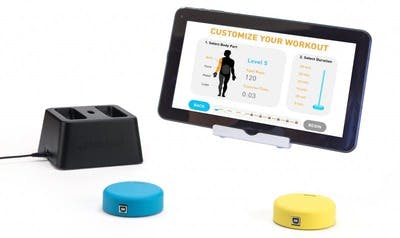
FitMi helps encephalon injury survivors regain the ability to walk by encouraging high repetition of full-body rehab exercises. Unlike written sheets of exercises, which can grow boring and tedious, FitMi creates an interactive abode therapy experience. Users interact with the blue and xanthous "pucks" (by gripping, pressing, or stomping, for example) to practice therapeutic exercises.
FitMi is also adaptive and unlocks more difficult exercises as you lot amend. Earlier every session, you lot tin cull which muscles groups you lot desire to piece of work on, including the legs and cadre, which help target the areas necessary for walking.
7. Vestibular/Vision Therapy
Sometimes remainder problems stem from inner ear or vision problems, which may require a different approach to treatment. In these cases, vestibular therapy and/or vision therapy can often care for these problems and aid y'all regain your balance again.
8. Chore-Specific Gait Training
Individuals that have enough movement to walk with assistive devices, such equally walkers or canes, can also benefit from task-specific training, which simply involves walking.
Walking provides dandy stimulation to the brain and helps yous practise the very activity that you want to improve. Individuals should exercise care and caution when attempting this step, though.
As your walking skills meliorate, you may progress to more difficult walking tasks, such equally walking on uneven surfaces or up and down stairs.
Never abandon assistive devices without a light-green light from your therapist. If you rely on a walker or four-indicate cane, information technology tin can be unsafe to carelessness these devices and effort to walk on your own.
Individuals with impaired gait are at a greater risk of falling, which can set dorsum your recovery. Take slap-up care with yourself and apply whatever devices recommended by your therapist.
9. Intensive Mobility Gait Grooming
The last stride in learning to walk again isintensive mobility gait training.
This type of gait training includes an aerobic aspect, where you will continuously perform a movement at moderate intensity.
Some examples of this training include riding a stationary bike or repeatedly standing upwardly and sitting downward — anything that gets your heart pumping.
The goal of intensive mobility training is to increment your endurance so that you lot tin can walk without tiring out besides quickly.
Relearning to Walk After Encephalon Injury
As you brand your way through all of these steps, your gait should slowly meliorate as you lot stimulate the brain and spark neuroplasticity. Walking subsequently brain injury tin can be a long and difficult process, but information technology is doable with difficult work and dedication.
Exist sure to work closely with your therapist, who tin recommend exercises you tin do at domicile. Y'all can likewise motivate yourself with interactive at-home therapy programs like FitMi, which is therapist-approved. We promise these steps help you lot become back on your feet with conviction.
Source: https://www.flintrehab.com/walking-after-brain-injury/
0 Response to "How to Make Some Walk Again After a Tbi"
Post a Comment